ACPR and CCDF Measurements with MATLAB System Objects
R2026bCCDF Measurements
This example shows how to use the power meter System object™ to measure the probability of a signal's instantaneous power being greater than a specified level over its average power. Construct a powermeter object and set the Measurement and ComputeCCDF properties.
pm = powermeter(Measurement="Peak-to-average power ratio",ComputeCCDF=true);Set OFDM parameters.
fftLength = 256;
cyclicPrefixLength = 32;
nullIdx = [1:6 fftLength-4:fftLength]';
numFrames = 20;
ofdmInputSize = fftLength - numel(nullIdx);
ofdmOutputSize = fftLength + cyclicPrefixLength;
Generate the 64-QAM and OFDM signals for evaluation.
data = randi([0 63],ofdmInputSize,numFrames);
% Apply 64-QAM modulation
tmpQAM = qammod(data,64);
% Save the signal data
qamSig = tmpQAM(:);
% Apply OFDM modulation to the QAM-modulated signal
ofdmSig = ofdmmod(tmpQAM,fftLength,cyclicPrefixLength,nullIdx);
Determine the PAPR values for the two signals. The two signals being evaluated must be the same length so the first 4000 symbols are evaluated.
PAPR = pm([qamSig(1:4000),ofdmSig(1:4000)]);
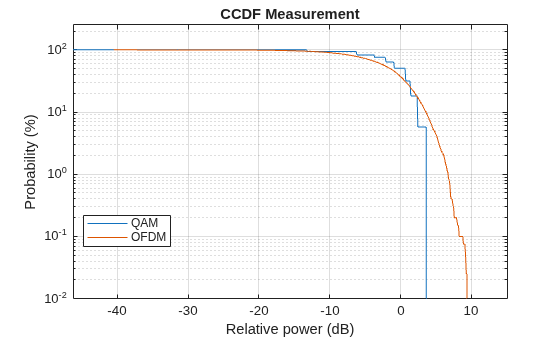
Plot the CCDF data. Observe that the likelihood of the power of the OFDM modulated signal being more than 3 dB above its average power level is much higher than for the QAM modulated signal.
plotCCDF(pm)
legend('QAM','OFDM','location','best')
Compare the PAPR values for the QAM modulated and OFDM modulated signals.
fprintf('\nPAPR for 64-QAM = %5.2f dB\nPAPR for OFDM = %5.2f dB\n',...
    PAPR(1), PAPR(2))
PAPR for 64-QAM =  3.65 dB
PAPR for OFDM =  9.44 dB
You can see that by applying OFDM modulation to a 64-QAM modulated signal, the PAPR increases by 5.8 dB. This means that if 30 dBm transmit power is needed to close a 64-QAM link, the power amplifier needs to have a maximum power of 33.7 dBm to ensure linear operation. If the same signal were then OFDM modulated, a 39.5 dBm power amplifier is required.

