Interface (2P-TL)
R2026bTwo-phase fluid and thermal liquid network interface
Interface (2P-TL) block

To add a block to a model, double-click the canvas and start typing the block name. Then, select the block from the list.
Libraries:
Simscape /
Fluids /
Fluid Network Interfaces
Description
The Interface (2P-TL) block represents a flow connection between a two-phase fluid network and a thermal liquid network. Pressure, temperature, and mass flow rate are equal at the interface. The block does not transfer the fluid properties of each fluid network across the interface. To conserve fluid properties, ensure that the Thermal Liquid Properties (TL) block and the Two-Phase Fluid Properties (2P) block have the same settings.
The fluid at the 2P port must remain subcooled. You can use the Two-phase fluid subcooled liquid check parameter to choose what action the block performs if the fluid does not meet this condition.
Mass and Momentum Balance
The block conserves mass such that
where:
is the mass flow rate into port TL.
is the mass flow rate into port 2P.
The port pressures are equal:
Energy Balance
The temperature is constant between the two fluid ports. The block calculates the energy balance over the interface as
where:
ΦTL is the energy flow rate into port TL.
Φ2P is the energy flow rate into port 2P.
hTL is the specific internal energy at port TL.
h2P is the specific internal energy at port 2P.
vTL is the specific volume at port TL.
v2P is the specific volume at port 2P.
wTL is the flow velocity at port TL
w2P is the flow velocity at port 2P
S is the value of the Cross-sectional area at ports 2P and TL parameter.
Examples
This example uses test harnesses to compare the Interface (2P-G), Interface (2P-MA), and Interface (2P-TL) blocks. A test harness is a minimum viable model that you can use to parameterize blocks or isolate dynamics.
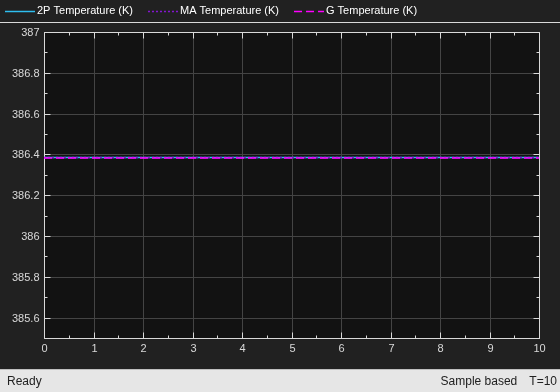
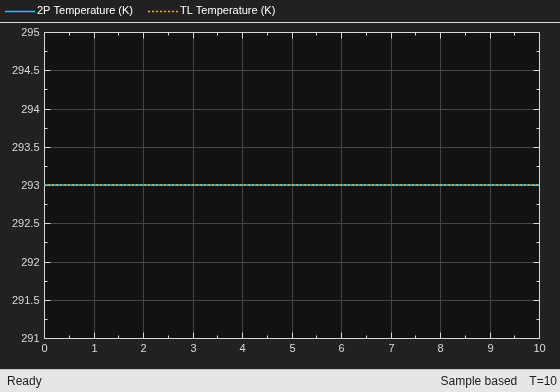
This model contains two networks that both use water as the working fluid. In the top network, the water in the Reservoir (2P) block is 385 K and is fully vapor, which allows it to convert to gas or moist air at the respective interface. In the bottom network, the water in the Reservoir (2P) block is 293 K and fully liquid, which allows it to convert to thermal liquid at the interface.
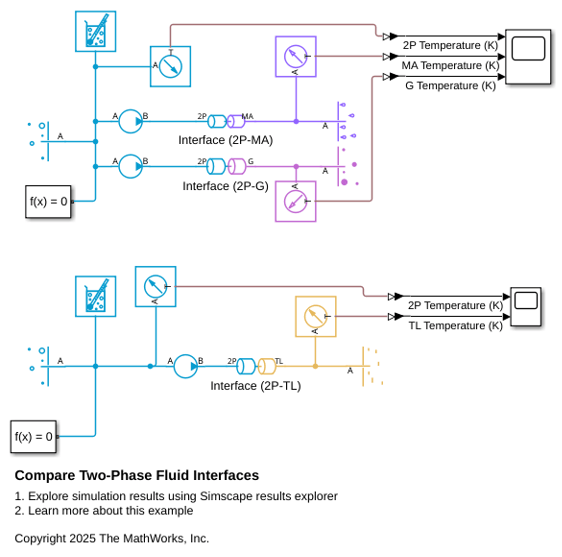
Interface blocks preserve the overall fluid mixture Through and Across variables across the interface. The Scope blocks show that the temperatures of each fluid remain the same on either side of the interfaces.
Ports
Conserving
Parameters
Extended Capabilities
Version History
Introduced in R2021a

